


Six Percent of COGS Is Not a Discount. It Is a Multiple.
Why foodservice procurement is the most underworked value-creation lever in a restaurant portfolio — and why it almost never shows up in diligence.
Most value creation plans written for restaurant assets are built on the revenue line — new units, remodels, day part expansion, a price increase the brand can absorb. Almost none are built on the second-largest line in the P&L, the one already running, already contracted, and already leaking.

Food cost gets modeled. Food cost rarely gets audited.
The leak does not appear on any single invoice
A twenty-unit group generates well over one hundred thousand invoice lines a year. The overcharge does not sit on one of them in a form anyone would notice — it sits at a few cents per case, spread across thousands of lines, multiple distributors, and twelve months. It is a rounding error at the line level and a seven-figure number at the portfolio level.
The monthly close reports what was paid, not what should have been paid, which means the system producing the number is the same system that would have to flag it. That is not a discipline problem at the portfolio company. It is a measurement gap.
Four failure modes, and they repeat across nearly every asset
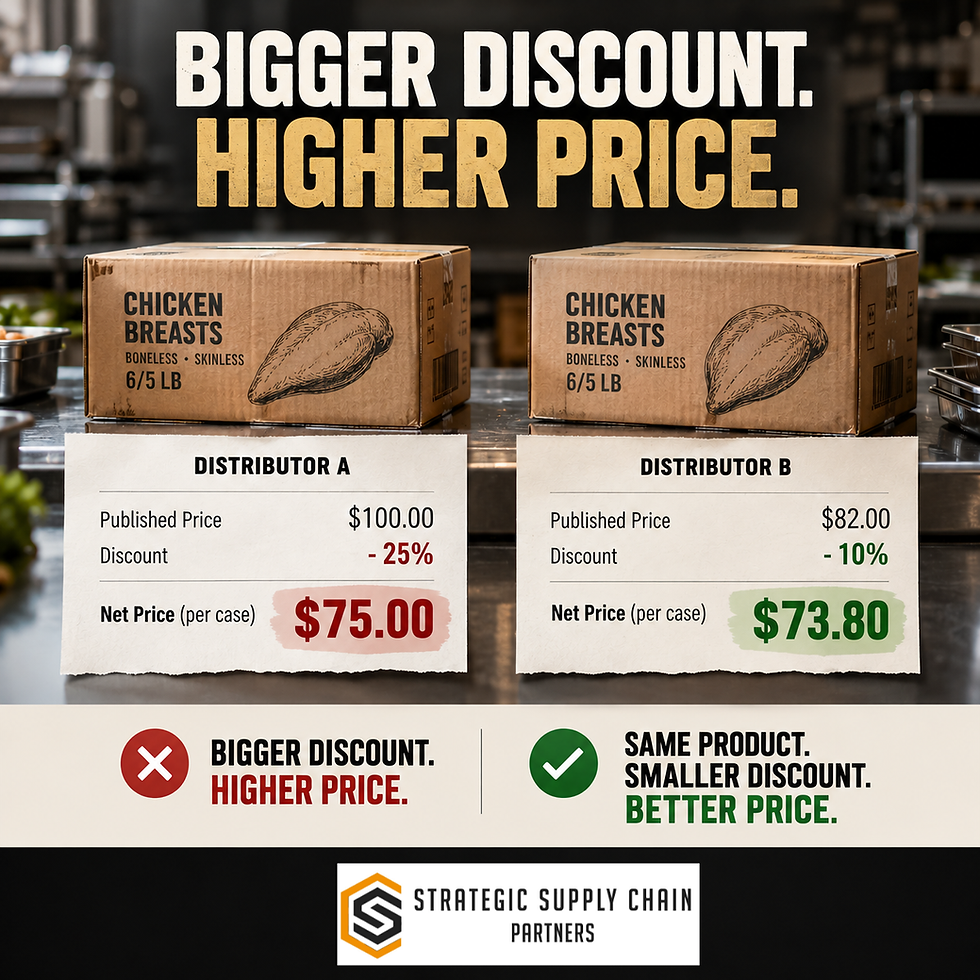
Uncorrected deviations — pricing negotiated, agreed, and documented, then never applied to the invoice.
Mis-awarded bids — awards decided on a sample basket, so the distributor who wins the sample loses the basket — and the error compounds for the term of the agreement.
GPO contract gaps — off-the-shelf portfolios built for the average member, strong in some categories and mediocre in others, and the mediocre categories are frequently where the volume actually is.
Unchallenged increases — commodity, freight, and packaging justifications accepted at the category level rather than tested item by item against BLS PPI, USDA AMS, and NDPSR data.
Who is actually doing the purchasing
At a group with twenty to eighty units and no dedicated procurement staff, the purchasing function belongs to the distributor sales representative — competent, responsive, often genuinely helpful, and compensated on the margin of the account. This is not misconduct. It is arithmetic, and it produces exactly the result the arithmetic predicts.
The same question applies to whoever advises the group on the deal itself. A group purchasing organization is generally paid by suppliers, out of the volume it routes to its contracts. That model rewards routing volume to contracts that pay the GPO; it does not reward the lowest net landed cost on a particular SKU file. Sometimes the two point the same direction. The only way to know which case you are in is to have the arrangement tested by somebody carrying no supplier revenue — and a finding that the existing relationship is the right one is worth considerably more tested than assumed.
What the arithmetic does at exit
Take a group purchasing twenty million dollars of food and supplies annually. Recover six percent on a deviation-corrected, item-level basis. That is roughly $1.2 million.
To the operator, that is a very good year. To the sponsor, it is a permanent addition to EBITDA multiplied by the exit multiple — at nine times, close to eleven million dollars of enterprise value, created without a single incremental unit, incremental customer, or dollar of deployed capital.
Illustrative arithmetic, not a quote. The real number comes out of the baseline.
Where it fits in the hold period
Diligence — a baseline on one period of purchase data shows whether the procurement upside has already been harvested or is still sitting unclaimed. Both answers are useful. Only one of them is usually assumed.
First hundred days — no capital required, no operational disruption, nothing visible to the guest — one of the few items executable while management is still absorbing the rest of the plan.
Add-on integration — the largest and most consistently missed window. Every add-on arrives with its own distributor relationships, contract terms, and order guides. Rebidding the combined basket produces savings neither entity could reach alone, and the window narrows the longer acquired units run on legacy agreements.
Exit preparation — an asserted savings number gets discounted in a sell-side process. One documented as item-level realized variance against an approved baseline survives a quality of earnings review.
What it costs to find out
One period of purchase data from one portfolio company. We build the baseline and report, line by line, what the leakage looks like — deviations not applied, bids awarded against the basket, increases the index data does not support. You approve the baseline before anything else happens, and our fee comes only from savings recovered and verified. No retainer, no capital outlay at the portfolio company, no management fee drag at the fund.
If we find nothing, you have learned the asset is already tight, and it cost you an export. Most of the time, we find something.
Strategic Supply Chain Partners is an independent, contingency-fee foodservice procurement advisory serving multi-unit operators and PE-backed restaurant platforms. We take no supplier revenue.


Comments