


Published Price Is a Starting Point, Not a Deal

What foodservice operators should ask instead of "How big is my discount?"
Almost every distributor proposal speaks the same language: Published Price Less 10%. Less 15%. Less 25%. The bigger the number, the better the deal seems. But the discount percentage is one of the least reliable signals in foodservice purchasing, and focusing on it can cost operators real money.
What published price actually is
Published price, often called the price book or list price, is the distributor’s standard catalog price before any customer-specific discounts, deviations, rebates, contract pricing or negotiated markups are applied. Very few operators actually pay it. Instead, it serves as the reference point from which their negotiated price is calculated.
That is the problem. When your price is defined as a discount off a number the distributor controls, the discount tells you how far you are from the reference point, not what you are paying relative to what the product actually costs.
Why a bigger discount can still mean a higher price
Consider a case of chicken with a published price of $100. An operator negotiates a 25% discount and pays $75. That sounds strong, until you learn the distributor’s acquisition cost is $60. The operator is still paying $15 above cost, and the discount percentage gave no hint of it.
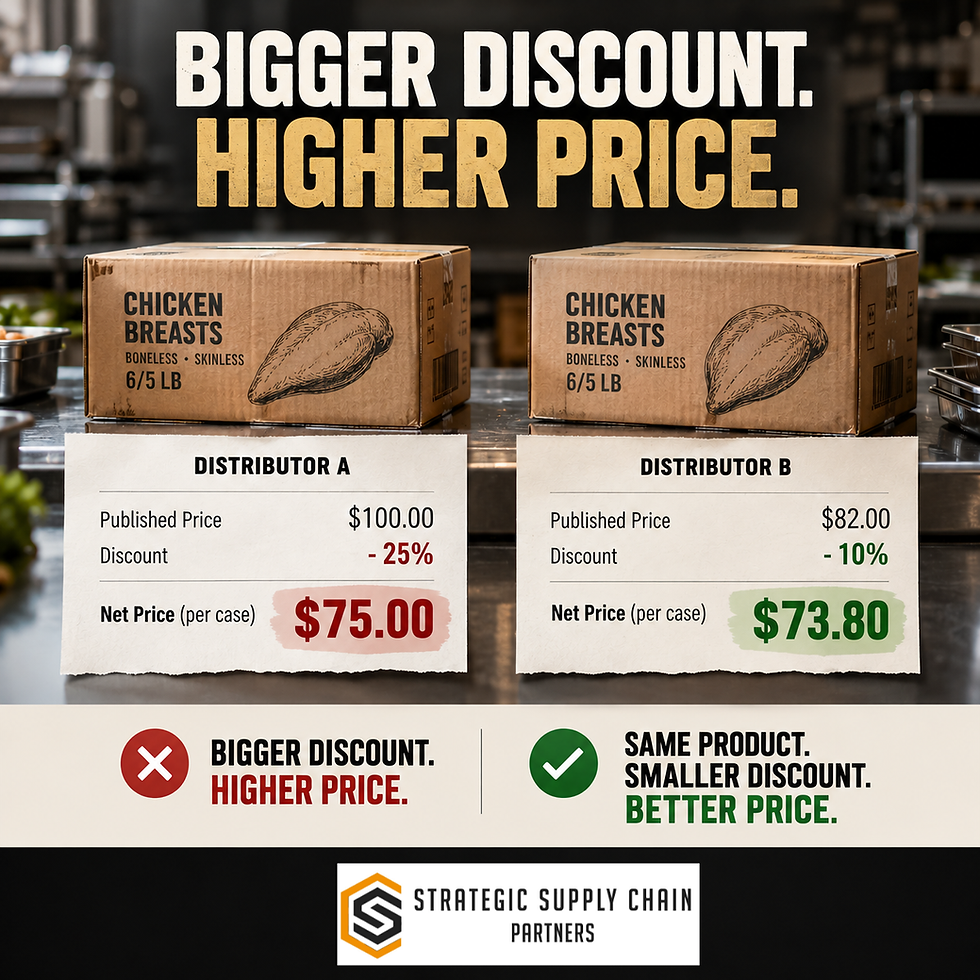
Now compare two offers for the same case:
Distributor A: published price $100, less 25% = $75.00
Distributor B: published price $82, less 10% = $73.80
The smaller discount is the better deal. Without the net price, the comparison is meaningless.
Where published-price contracts hide cost
Inflation passes through quietly. When a distributor revises its price book upward, a fixed percentage discount follows the book up. Your discount looks unchanged while your cost rises.
Benchmarking gets harder. Comparing percentages across distributors, locations or contract periods says little when every one starts from a different published price.
The same item can carry different prices. Multi-unit groups often find the same item number billed at different prices from one market or location to the next.
Pack size muddies the picture. A case of 6/5 lb and a case of 4/10 lb are not the same purchase. Without converting to cost per pound, gallon or each, comparisons can be off by a wide margin.
Three structures sophisticated operators use
1. Cost plus fixed fee
The operator pays the distributor’s actual cost plus a predetermined fee. This improves transparency and makes every price change easier to audit.
2. Fixed dollar per case
Instead of a percentage markup, the operator pays a set amount per case. When commodity prices rise, the distributor’s margin does not automatically rise with them.
3. Contracted or deviated pricing
Manufacturers and operators negotiate item-specific pricing that flows through the distributor. Common among larger chains and purchasing groups, it reduces price variability on the items that matter most.
None of these structures runs itself. Each needs regular invoice auditing to confirm that what is billed matches what was agreed.
The better question
The most important procurement question is not "What discount am I receiving from published price?" It is "How does my net price compare with distributor cost, the market price and my alternative purchasing channels?"
How SSCP helps operators get to the real number
SSCP brings large-company procurement expertise to independent restaurants, multi-unit operators and hospitality groups that do not have a purchasing department behind them. With nationwide insight across the supply chain, we help operators replace discount math with net-price facts:
Net-price benchmarking. We compare your line-item invoice prices against distributor cost indicators, current market prices and other operators’ pricing, so you know where you stand item by item, not percentage by percentage.
Contract structure and negotiation. We evaluate whether cost-plus, fixed fee per case or deviated pricing fits your volume and menu, then negotiate the agreement and the item pricing behind it.
Invoice auditing. We check that what you are billed matches what you agreed to, including consistent pricing for the same item across every location.
Like-item and pack-size analysis. We convert purchases to a common unit, cost per pound, gallon or each, to find where pack choice or brand choice is quietly driving cost.
Beyond the invoice. Because purchasing savings only matter if they reach the plate, we also support theoretical food cost, yields, portioning and menu pricing.
Our process is built around one standard: equal or better quality at an equal or lower price. Every recommendation we make is measured against it.
Wondering what your net price really is? Schedule a call with SSCP, and we will show you how your pricing compares.
Chris Rodrigue
Senior Operations Partner
Mobile: 985-778-1515
Micah Moore
EVP, Business Development | Partner
Email: micah.moore@ssc.partners
Mobile: 225 772 9730
Web: https://ssc.partners


Comments