


Big-Company Buying Power, Without the Big-Company Procurement Department
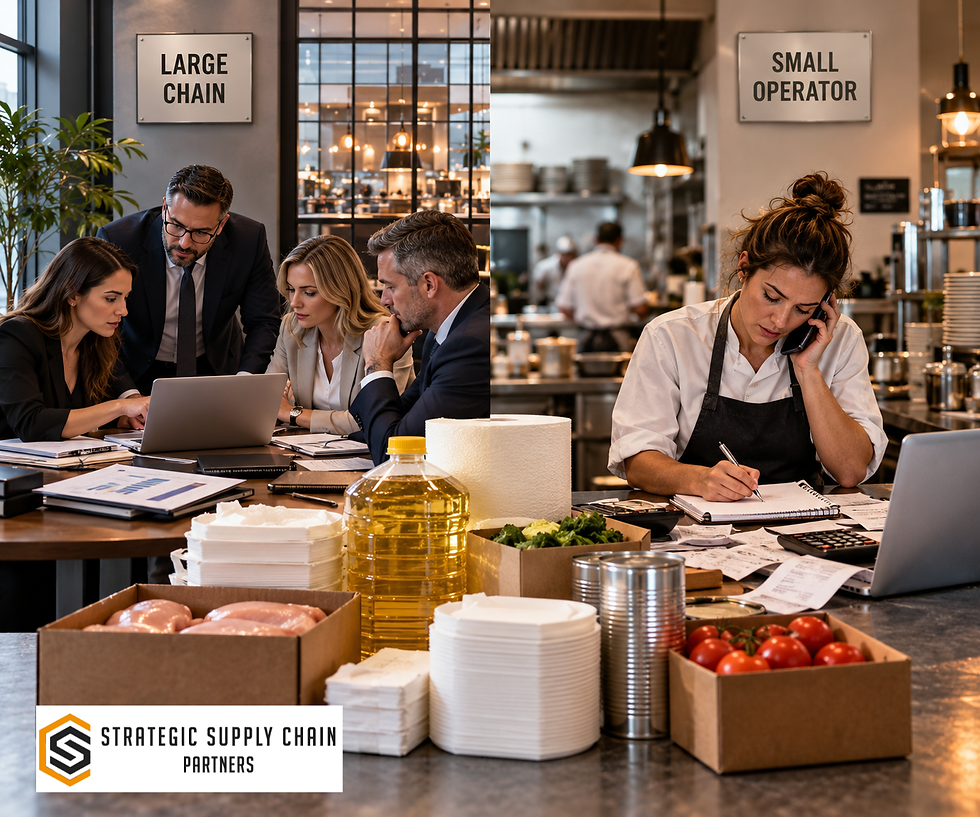
Walk into the purchasing office of a large restaurant chain or hotel group and you’ll find something most smaller operators never see: a team of people whose entire job is buying. They don’t cook, manage shifts, or fix the walk-in. They negotiate, analyze, audit, and plan, every day.
Now walk into a typical independent restaurant, a small hospitality group, or a growing multi-unit concept. Purchasing is usually handled by a chef, GM, or owner, squeezed in between everything else.
Both are buying the same chicken, the same fryer oil, the same paper goods. But they’re buying them in very different ways, and that difference shows up on the P&L.
How large companies buy
Large operators treat purchasing as a discipline, not a chore. A few things set them apart:
Dedicated expertise. Procurement professionals know how distributor pricing is built, what’s negotiable, and where the margin hides. They know what “cost-plus” really means and how to verify it.
Formal competitive bidding. Instead of collecting prices week to week, they run structured RFPs. Suppliers compete for a defined book of business, on defined terms, for a defined period.
Contracts, not order guides. Pricing structures, markups, product specs, delivery standards, rebate programs, and audit rights are all in writing. Everyone knows the rules.
Data and benchmarks. They know what they paid last quarter, what similar operators pay, and where the market is heading. Decisions are made against a baseline, not a hunch.
Ongoing accountability. Invoices are audited. Compliance is tracked. Suppliers are reviewed on performance, not just price.
Contingency planning. When a product goes short or a supplier stumbles, there’s already a plan B.
How smaller companies buy
Smaller operators are often just as sharp and just as cost-conscious. What they’re missing isn’t intelligence. It’s time, data, and leverage.
Purchasing typically runs through a relationship with a sales rep and an order guide. Prices are accepted, or shopped around week to week. Markups are rarely known. Specs may not be written down. Invoices get paid, not audited. And when something goes wrong in the supply chain, the smaller operator often finds out last.
None of this is a failure of effort. It’s a structural gap. A 5-unit group can’t justify a full-time procurement director. An independent owner can’t benchmark their pricing against hundreds of other operators.
The gap isn’t just about volume
Most people assume large companies get better deals simply because they buy more. Volume matters, but it’s only part of the story.
Much of the large-company advantage comes from process and knowledge: knowing what to ask for, how to structure the agreement, what fair pricing looks like, and how to hold suppliers accountable afterward. A smaller operator who negotiates the right structure, with the right information, can capture a meaningful share of the benefits large companies enjoy, without matching their volume.
That’s where we come in.
Our mission: large-company expertise for smaller companies
Strategic Supply Chain Partners exists to close that gap. Our mission is simple: bring large-company procurement expertise to small and mid-sized operators.
We act as the purchasing department you don’t have. We run a structured, proprietary RFP process. We define specs, benchmark pricing, negotiate supplier agreements with the right structure, and help make sure those agreements are honored over time. You get the discipline and results of a professional procurement function, without the overhead of building one.
Why nationwide insight matters
One of the biggest advantages large companies have is perspective. They see pricing, supplier performance, and market conditions across many locations and regions. A single operator sees only their own invoices.
SSCP works across the country and across the supply chain, and that broad view becomes your advantage:
Real benchmarks. We know what fair pricing looks like across markets, so you’re not negotiating in the dark. When a quote looks good, we can tell you whether it actually is.
Market awareness. Commodity swings, freight costs, labor pressures, and shortages ripple through the supply chain. Seeing those patterns early helps our clients time decisions and avoid surprises.
Supplier knowledge. We know which distributors and manufacturers perform well in which regions, which programs exist, and which suppliers keep their promises. That means better matches and fewer bad partnerships.
Knowing what’s negotiable. Because we see how agreements are structured across many operators, we know which terms suppliers will move on, and which “standard” terms aren’t really standard.
Faster problem-solving. When a disruption hits, broad relationships and visibility mean more options for alternatives and substitutions.
In short, you get the vantage point of a large buyer, even if you’re running one location.
Our commitment: equal or better quality, at equal or lower prices
Changing how you buy should never mean compromising what you serve. That’s why a simple standard is built into our process: we don’t recommend a supplier or product change unless it meets or exceeds your current quality at an equal or lower price.
Your specs set the bar. Your team approves the products. Savings only count if the quality holds up in your kitchen and on your guests’ plates.
What this looks like for you
Working with SSCP, smaller operators typically gain:
A clear picture of what they’re paying today and where the opportunities are
Competitive, structured bidding instead of week-to-week price chasing
Written agreements with transparent pricing, specs, and service commitments
Ongoing oversight so negotiated savings don’t quietly erode
Hours back every week for the people currently doing the buying
And because our model is built around savings, our success is tied directly to yours.
Let’s talk
You don’t need a corporate procurement department to buy like one. You need the expertise, the data, and a partner who’s done it before.
Schedule a call with SSCP. We’ll look at how you buy today, how that compares to how large operators approach the same categories, and where large-company expertise could make a difference for your business.


Comments